I Will Never Run Again – The Injured Runner’s Reassurance Program
The first injury is the physical one. It’s the stress fracture, the torn tendon, the IT band flare-up, and the plantar fasciitis that came outta nowhere. This is the one shows up on an MRI and has a name and a timeline and a physio appointment and a PT plan and painkillers (bonus if they’re from Mexico).
The second injury, though, is the fucking devil. It’s what happens when running stops and you’re suddenly left standing in front of your full-length bedroom mirror, naked, wondering what’s left of you without it. It’s quieter. It doesn’t have an X-ray. Nobody talks about it… especially not the running influencers who pivot to motivational content about “staying positive” the second they get hurt, as if the solution to grief is a better attitude.
It isn’t.
What running is actually doing for you
For a lot of us, running isn’t just exercise. It’s regulation. Self-accountability.
It gives us an excuse to wake up early. Got to bed late. Take time off during the day. It’s where you process the stuff you couldn’t process sitting still, or facing someone. It’s the daily proof that you’re moving towards something (whether tangible or not), progressing, existing in the way that feels intentional to you. Further, it’s maybe your identity. It’s your mantra: I am a runner.
And through that, you know, at least partly, who you are.
When that stops, be it abruptly or involuntarily, because your plantar fascia or your tibia or your IT band made a unilateral decision without consulting you, you don’t just lose fitness.
You lose:
- The routine.
- The morning anchor.
- The proof.
- The identity.
- The community.
- The race you trained eight months for.
- The one thing that was getting you through a hard time.
That’s not nothing.
The fitness loss is real. And also not the point.
Fitness may be the one thing everyone focuses on, whether they admit to it, or not. I’ve shared the roads and trails with the most relaxed friendly people I’ve ever met. And still they are concerned about fitness, maintaining their bodies, and looking a certain way. And that’s rad. Because I 100000% do too. And that deserves a real answer instead of false reassurance.
Yes, you lose some fitness during a long injury.
The aerobic adaptations you built; the mitochondrial density, the capillary development, the cardiac efficiency begin to reverse over time. Shit is real, and it sucks.
For inspiration: “Take care of Tomorrow Peter”
Three to six weeks off won’t erase months of training. Your body remembers more than you think. “Muscle memory” is real. The return to fitness after a break is almost always faster than the initial build. You’re not starting over. IT’s fucking frustrating, for sure, but it’s not nothing.
Also, fitness loss is not actually why you feel terrible right now. You feel terrible because the thing that made you feel like yourself is gone. The fitness is the thing you’re allowed to grieve. The identity crisis is the thing you’re actually grieving.
Running as an identity, and suddenly losing your sense of self
Running can quickly become the answer to the question of who we are. You’re a runner. You have miles. You have races. You have PRs and Strava segments and way too much gear that all smells amazing.
Then. It stops. You’re injured. And if you’re anything like everyone in the world, you will keep running through the injury even after friends tell you to stop. Then your doctor tells you to stop. And it’s not until you wake up unable to walk that you think, “Fuck. I should take today off.”
Then it’s a second day. And soon, you’re out for awhile. And you enter the self-built prison: the belief that the injury has taken not just the running but the whole identity, the whole proof of who you are. The “I can’t run, therefore I am nothing” spiral that nobody wants to admit they’re in but almost everyone injured goes through.
This is where shit gets real: you were always more than the running. At least this is what I tell myself.
I am the running AND the person who needed it, and the dad, and the friend, and the bad chef, and the amateur magician, and the binge-watcher, and the designated driver. A running injury just stripped the convenient answer away and left me with the harder question that sucks to answer:
Who am I when nobody can see what I’m doing and I can’t get the same validation?
Sit with that. And make take a second to figure out your worth beyond how others see you.
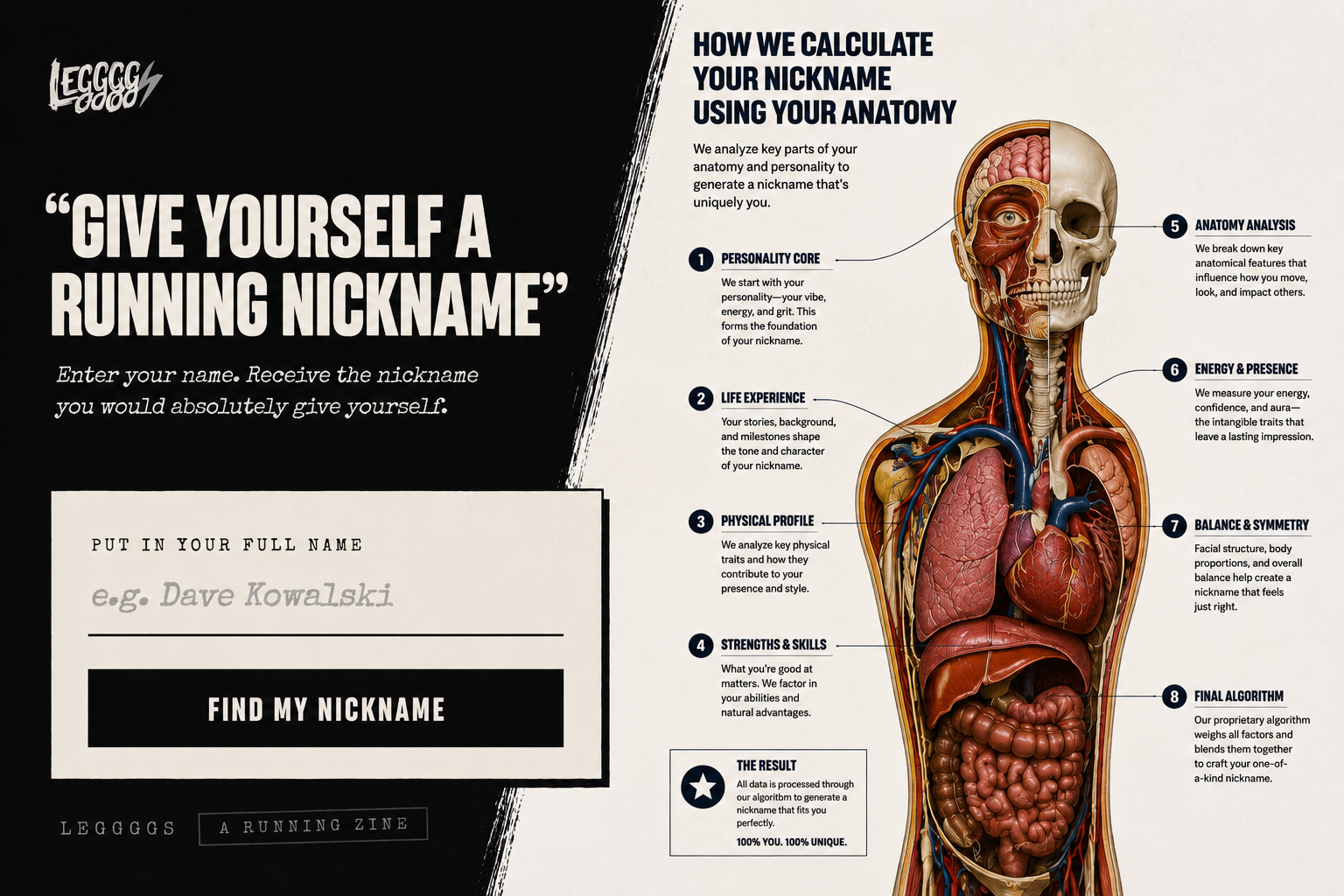
While you’re doing that, snag your new running nickname:
What helps (and what doesn’t)
Motivational content can get fucked.
Influencers turning their injury into a “journey.” People telling you to “trust the process” or “use this time to work on your weaknesses.” All of that is a performance of resilience that has nothing to do with the actual experience of being hurt and having to stop.
What actually helps, in my experience: naming what you’re actually losing. Not “I’m injured” but, “I’m scare about not getting back the 1-2 hours a day I had for only me” or “I’ll never PR again” or “my shoes are just collecting dust.” Be specific. Be visceral.
The more dramatic, the better, tbh, because the worse it gets, the more you can realize that this is temporary; because you’ve looked at the actual evidence and decided to believe it. The injury will heal. The fitness will come back. The identity doesn’t go anywhere. You just have to live in a gap for a while. Plus, it’s comfortable in the gap. We have chips.
Final thought
You are not just a running profile.
You are a complicated person who runs. HUGE difference.
The injury found the gap between those two things and is currently living in it, making everything feel shitty and precarious.
You’re more than the miles. You’re more than a Strava kudo.
And the people who actually know you aren’t wondering “when you’re getting back to running.” If they are, fuck them.
Injured Runner Reassurance Program
Put something down and get an honest response. Forego the pep talk, and motivational nonsense.
We got you.